Llámanos en cualquier momento
+8613570976228



Sodium Hypochlorite Generators vs. Traditional Chlorine Gas Systems: Which Is Better for Industrial Water Treatment?
When designing or upgrading industrial water disinfection facilities, project managers and EPC contractors often face a critical architectural dilemma: should they stick with traditional chlorine gas or transition to a modern sodium hypochlorite generator? As safety regulations become more stringent and supply chain vulnerabilities increase, evaluating the true total cost of ownership (TCO) has never been more important for plant engineers navigating today's complex procurement landscape.
Water disinfection is the absolute cornerstone of municipal safety and industrial process reliability. For decades, pressurized chlorine gas was the undisputed industry standard due to its incredibly low initial cost and powerful oxidizing properties. However, the inherent safety hazards of storing and transporting liquefied toxic gas have forced a massive industry shift. Modern facilities are increasingly turning towards onsite chlorine generation systems to eliminate hazardous liabilities while maintaining superior microbiological control across large-scale water networks.
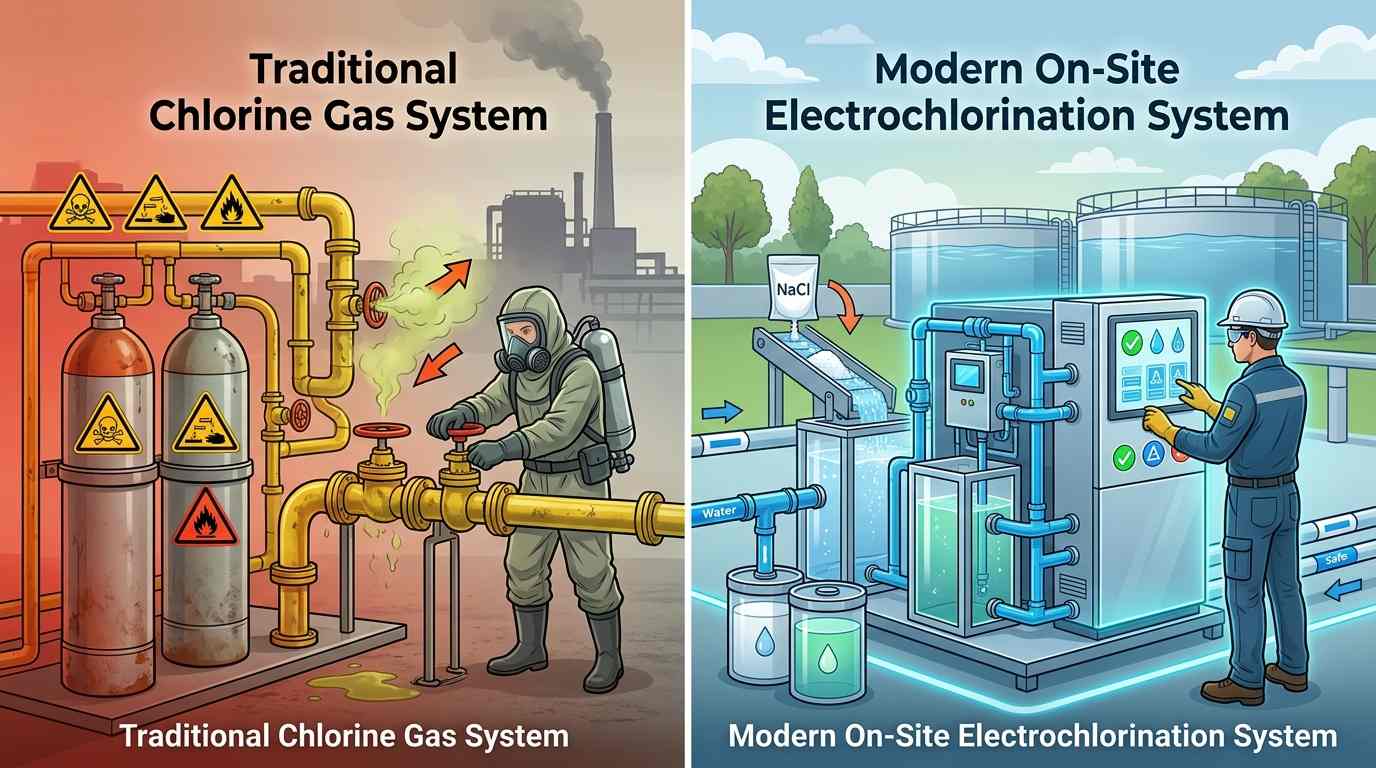
While liquefied chlorine gas boasts high initial efficiency, its operational overhead is deceptively high. Facilities utilizing chlorine gas are subjected to rigorous federal and local risk management mandates, requiring extensive safety infrastructure that drains maintenance budgets year after year:
• Mandatory Scrubbers & Leak Detectors: In the event of a valve failure or line rupture, toxic gas clouds can threaten surrounding communities. This necessitates expensive, multi-layer gas scrubbing systems, rapid-response emergency shut-off valves, and constant sensor calibration.
• Specialized Personnel Training: Operators must undergo continuous, high-level hazardous material (Hazmat) training and maintain Self-Contained Breathing Apparatus (SCBA) gear on-site at all times.
• Volatile Delivery Logistics: Transporting pressurized gas cylinders exposes your facility to strict transport regulations, fluctuating carrier fees, and potential delivery delays during extreme weather events.
An industrial electro chlorination system solves these vulnerabilities by utilizing electrochemical activation. Instead of storing toxic chemicals, the system consumes three safe, readily available elements: water, food-grade salt, and electricity.
When a direct current passes through a diluted brine solution inside a specialized electrolytic cell powered by durable MMO titanium anodes, it safely produces a non-hazardous 0.8% sodium hypochlorite solution on demand. This fresh disinfectant is stored locally and dosed directly into the water stream, completely bypassing the risks associated with bulk commercial bleach degradation or high-pressure gas leaks.
Pro Tip for EPC Contractors: Because the sodium hypochlorite produced onsite is strictly maintained at a 0.8% concentration, it falls well below the 1% threshold for hazardous materials. This single engineering choice can entirely remove a facility from strict EPA Risk Management Plan (RMP) requirements.
To help project engineers and procurement teams make data-driven decisions, the following matrix breaks down the core operational differences between the two technologies:
| Performance Metric | Traditional Chlorine Gas | Onsite Hypochlorite Generator |
| Safety Classification | High Risk (Toxic inhalation and explosion hazard) | Non-Hazardous (0.8% solution threshold) |
| Regulatory Burden | Severe (Strict EPA/OSHA Risk Management Plans) | Minimal (Standard industrial water safety) |
| Raw Material Cost | Low initial chemical cost, highly volatile shipping overhead | Very Low & Stable (Requires only standard salt and power) |
| SCADA Automation | Complex (Requires specialized vacuum regulators) | Seamless (Plug-and-play PLC integration for dosing) |
When building a financial model for your plant, looking solely at CAPEX is a dangerous trap. While a chlorine gas setup typically features a lower initial capital expenditure, its long-term operating expenses (OPEX) accumulate rapidly. Insurance premiums for handling toxic gas, mandatory scrubber maintenance, frequent valve overhauls, and specialized compliance reporting quickly erode any initial savings.
Conversely, modern onsite generation units offer a highly predictable and rapid ROI, often paying for themselves within 2 to 4 years. By purchasing raw salt in bulk and utilizing highly efficient electrolysis, facilities insulate themselves from chemical market price inflation, ensuring long-term financial stability.
Today's industrial projects are heavily vetted on their environmental footprint. Relying on traditional chlorine gas means depending on a continuous fleet of heavy-duty diesel trucks transporting hazardous chemicals across highways and through local municipalities. Transitioning to onsite generation drastically reduces your facility's Scope 3 emissions by eliminating these continuous freight deliveries, supporting corporate sustainability goals and greener community relations.
For plant engineers and EPC contractors designing the next generation of resilient water infrastructure, moving away from toxic gas in favor of an advanced industrial water disinfection system is a proven strategy. It eliminates catastrophic safety risks, safeguards local communities, and guarantees long-term operational cost efficiency.
Q: Is the disinfecting power of onsite hypochlorite equivalent to chlorine gas?
A: Absolutely. When dissolved in water, both chlorine gas and sodium hypochlorite form hypochlorous acid (HOCl), which is the active germ-killing agent. Your facility's disinfection efficacy remains completely uncompromised.
Q: How difficult is it to retrofit an existing plant from gas to onsite generation?
A: Modern skid-mounted generation systems are engineered for modular integration. They can be installed alongside existing dosing lines with minimal disruption. Because they come with advanced PLC panels, they connect effortlessly to your plant's existing SCADA automation framework for precise, real-time dosing.
Q: What ensures the long life of an onsite generator's electrolytic cell?
A: The secret lies in the electrodes. High-quality systems integrate dimensionally stable anodes (DSA) made of pure titanium and coated with precious metal oxides (like Ruthenium-Iridium). This prevents substrate corrosion and ensures years of continuous, high-efficiency chlorine production with minimal maintenance.
Derechos de autor @ Esegen (Guangzhou) Technology Co., Ltd Reservados todos los derechos.
 Network compatible con